
TL;DR
Training changes a model's learned parameters; inference uses those parameters to generate images. Photo uploads can support either process, so buyers should confirm the personalization method, compare identity consistency, and check retention terms separately before choosing a service.
Uploading a selfie doesn't automatically mean an AI model is being trained. The distinction behind AI photo generator training vs inference matters for headshot quality, turnaround, and data handling. A service might adapt a model to a person, use reference photos during generation, or combine both approaches.
For professionals exploring Looktara, understanding these stages makes product descriptions easier to assess without assuming a particular architecture.
Generative AI: Artificial intelligence that uses generative models to create content, including images, text, video, and audio.
Article navigation:
- Training and inference compared
- The uploaded-photo workflow
- Choosing a personalization approach
- Product evaluation
- Frequently asked questions
Table of Contents
What is the difference between training and inference?
Training changes an AI model's learned parameters, while inference uses existing parameters to produce an output. In photo generation, training teaches or adapts image-making behavior; inference creates a portrait from inputs such as prompts and reference photos. Uploading an image alone doesn't establish which process a service uses.
Plain-language definitions side by side
The key difference is whether the process updates learned parameters.
| Term | Plain-language meaning | Role in a photo generator |
|---|---|---|
| Base-model training | Learning patterns from a training dataset | Establishes general image-generation abilities |
| Fine-tuning | Further training of an existing model | Can adapt behavior toward a person or style |
| Adapter training | Learning a smaller set of additional parameters | Can personalize a model without updating every base parameter |
| Inference | Running a model to produce an output | Generates a requested portrait |
| Reference conditioning | Supplying guidance during inference | Uses an image or its representation to guide generation |
Model weights: Numerical parameters learned during training.
Conditioning: Information that guides generation, such as a prompt, pose, or identity reference.
A useful distinction: inference can calculate a representation of a face without updating the generator's weights. Processing a photo and learning from it aren't interchangeable.
Architecture changes the implementation
Different architectures can perform the same broad training and inference roles. Diffusion models, generative adversarial networks, and other systems need not share the same personalization pipeline.
The 2022 paper Hierarchical Text-Conditional Image Generation with CLIP Latents examines a particular image-generation approach, not a universal blueprint for headshot services.
A provider's word "training" needs a technical definition: it could describe base-model learning, customer-specific adaptation, or a loosely named setup stage.
How do uploaded photos become generated portraits?
Uploaded photos become generated portraits through a workflow that may include preparation, personalization, inference, and storage.
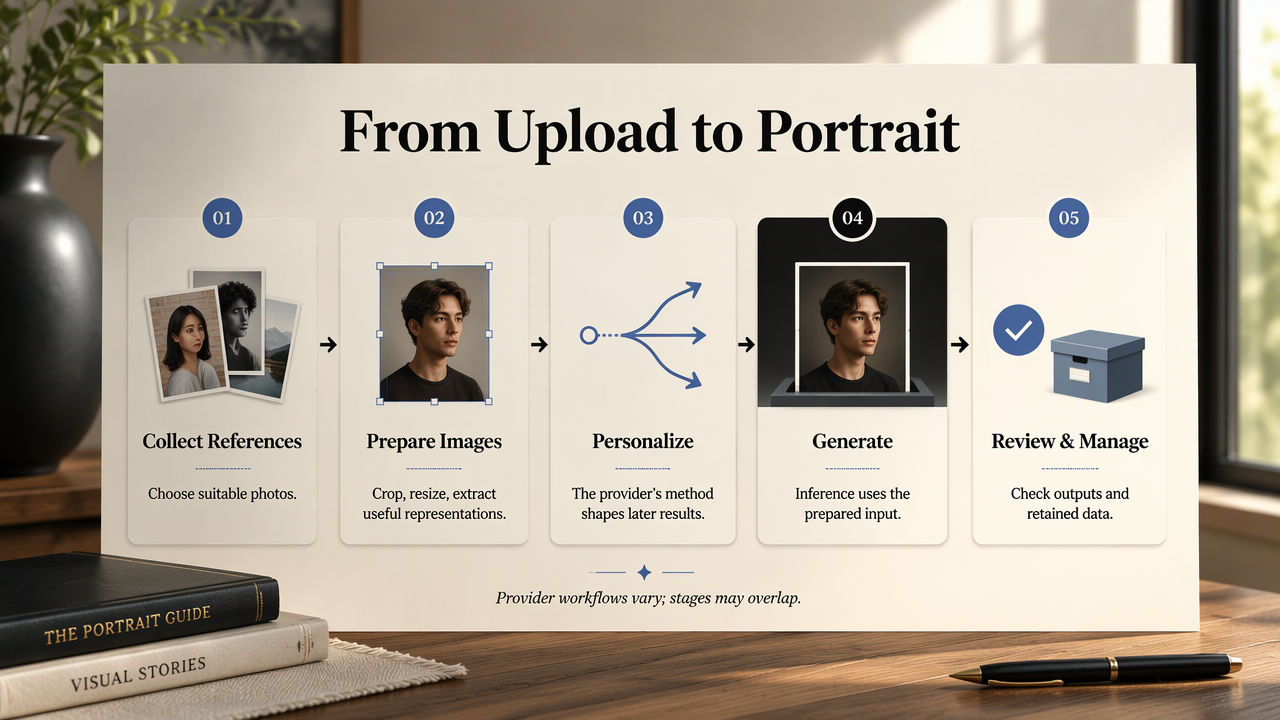
- Collect suitable reference photos.
- Prepare images and extract useful representations.
- Apply the provider's personalization method.
- Generate portraits through inference.
- Review outputs and manage retained data.
These stages aren't necessarily separate jobs, and their implementation varies by provider.
Uploads and personalization serve different purposes
Uploads provide input material; personalization determines how that material influences later results. Preparation may include cropping, resizing, or assessing image suitability. None of those operations, by itself, means the generator has undergone training.
A training-based workflow may create person-specific parameters. A reference-based workflow may instead supply identity information during each generation request. Hybrid services can combine these methods.
For a freelancer seeking a LinkedIn portrait, the practical goal is recognizable identity across useful compositions, not a particular architecture. Several clear reference views may provide more useful information than near-duplicate photographs, although upload requirements remain provider-specific.
Generation and retention need separate explanations
Generation creates the portrait; retention determines what remains after processing. A saved representation can support later requests without requiring the original upload to be processed again, depending on the system.
Retention questions should distinguish these records:
- Original uploads: The submitted photo files.
- Derived representations: Encodings, embeddings, or other processed information.
- Personalized parameters: Any customer-specific learned weights or adapters.
- Generated outputs: Finished portraits and their associated records.
Deletion of one category doesn't automatically describe deletion of the others. Buyers should also ask whether customer-specific processing is separate from permission to use uploads for broader model improvement.
The 2021 report On the Opportunities and Risks of Foundation Models examines foundation models and their opportunities and risks. Its broad scope provides background, not evidence of any photo provider's retention practices.
Which approach fits professional photo needs?
The best personalization approach is the one that meets the intended photo requirements at an acceptable total cost and turnaround. Training-based and reference-based methods both deserve evaluation through sample outputs. Neither label alone establishes identity accuracy, natural appearance, or suitability for a professional profile.
Who should pick which workflow?
Repeat-use buyers should examine consistency, while occasional buyers should emphasize setup effort and usable results.
| Buyer need | Approach worth evaluating | Evidence to request |
|---|---|---|
| Recurring brand portraits | Persistent personalization, trained or reference-based | Identity consistency across separate sessions |
| A single profile update | Low-setup generation workflow | Relevant samples and generation turnaround |
| Frequent changes of setting or clothing | Flexible conditioning and generation controls | Examples across varied prompts |
| Specific data-handling requirements | Clearly documented processing and retention | Policies covering uploads and derived records |
Entrepreneurs may value repeatable imagery for presentations and websites. Dating-profile users may prioritize a natural likeness over dramatic styling. Both groups benefit from judging outputs against the intended use rather than choosing by technical terminology alone.
Setup cost and generation cost are different
Total cost includes preparation or personalization plus subsequent image generation. Training can involve an upfront computation stage; inference still consumes computing resources each time images are produced.
Reference-based generation may avoid customer-specific weight training, but reference processing also requires computation. Provider packaging can combine these costs, so a price labeled "training" or "generation" doesn't reveal the full technical workload.
A practical comparison should record setup charges, included outputs, regeneration terms, and the effort needed to select usable portraits.
What to watch in 2027
A useful direction to watch in 2027 is clearer disclosure of personalization methods and stored identity information. Buyers should look for explanations that distinguish trained parameters, reference conditioning, and hybrid workflows rather than treating every personal photo service as technically identical.
Better buying questions focus on observable results and documented processing, not promises attached to an architecture label.
How Looktara handles this
Looktara is a relevant option for exploring AI-generated imagery, while its exact training and inference implementation should be confirmed through current product documentation. The supplied context establishes the product and its use-case pages, rather than specifying how uploads become personalized outputs.

Match the image destination to the evaluation
A clear publishing goal gives the product evaluation a concrete starting point. Fitness businesses can explore the LinkedIn product-photo generator page for professional-channel imagery or the Instagram product-photo generator page for social content.
Those destinations help frame use cases; they don't establish a personal-headshot training architecture. For each intended workflow, useful confirmation points include:
- The required upload types and preparation steps.
- Whether personalization changes learned parameters.
- Which settings remain available during generation.
- How saved inputs support future sessions.
Current product information on looktara.com can support that evaluation alongside relevant image examples.
Frequently asked questions about photo generation
The most useful follow-up questions separate model changes, input quality, storage, and repeat generation.
Does every uploaded selfie train an AI model?
No. A selfie may serve as a reference during inference, undergo preparation, or contribute to customer-specific training. The upload action alone doesn't identify the method. A provider should explain whether any learned parameters change and whether uploads are also eligible for broader model improvement under separate terms.
Does better training guarantee a better headshot?
No. A headshot also depends on reference quality, generation settings, composition, and output selection. Training can influence personalization, but its presence doesn't guarantee a natural or recognizable portrait. Evaluation should compare suitable examples against the actual goal, such as a restrained professional profile or a consistent brand-photo series.
Does inference mean photos aren't stored?
No. Inference describes computation, not a retention policy. A service can generate images without customer-specific training and still store uploads or derived representations. The 2021 survey Advances and Open Problems in Federated Learning addresses distributed learning; it isn't evidence that a particular photo service processes images locally or deletes them.
Can a personalized model generate new photos without retraining?
Often, yes. Saved personalized parameters can be used for later inference, while a reference-based service may reuse stored identity information or request new uploads. New prompts don't inherently require retraining. Whether updated reference photos trigger fresh adaptation, replace saved representations, or simply guide another generation depends on the provider's workflow.
Conclusion
AI photo generator training vs inference is a distinction between changing learned parameters and using them. The next step is to choose one target portrait style, compare relevant samples, and request clear explanations of personalization and retention. For a Looktara evaluation, those criteria create a practical checklist before committing to a larger image batch.
Generated by EarlySEO.com